
We check where our food and clothes come from – what about toys?
If you want to buy Norwegian and Nordic toys, there are several small makers. Pangea and Beljo make wooden toys in Norway. Viking Toys, Dantoy, Plus-Plus and Micki make toys in Sweden and Denmark. Rakkerungene, HiRO and Qubs are Norwegian brands with ideas of their own: soft toys in natural materials, and sound and learning without a screen.

Camilla Næristorp
- Founder, Loopyty
- 7 min read
With help from AI tools
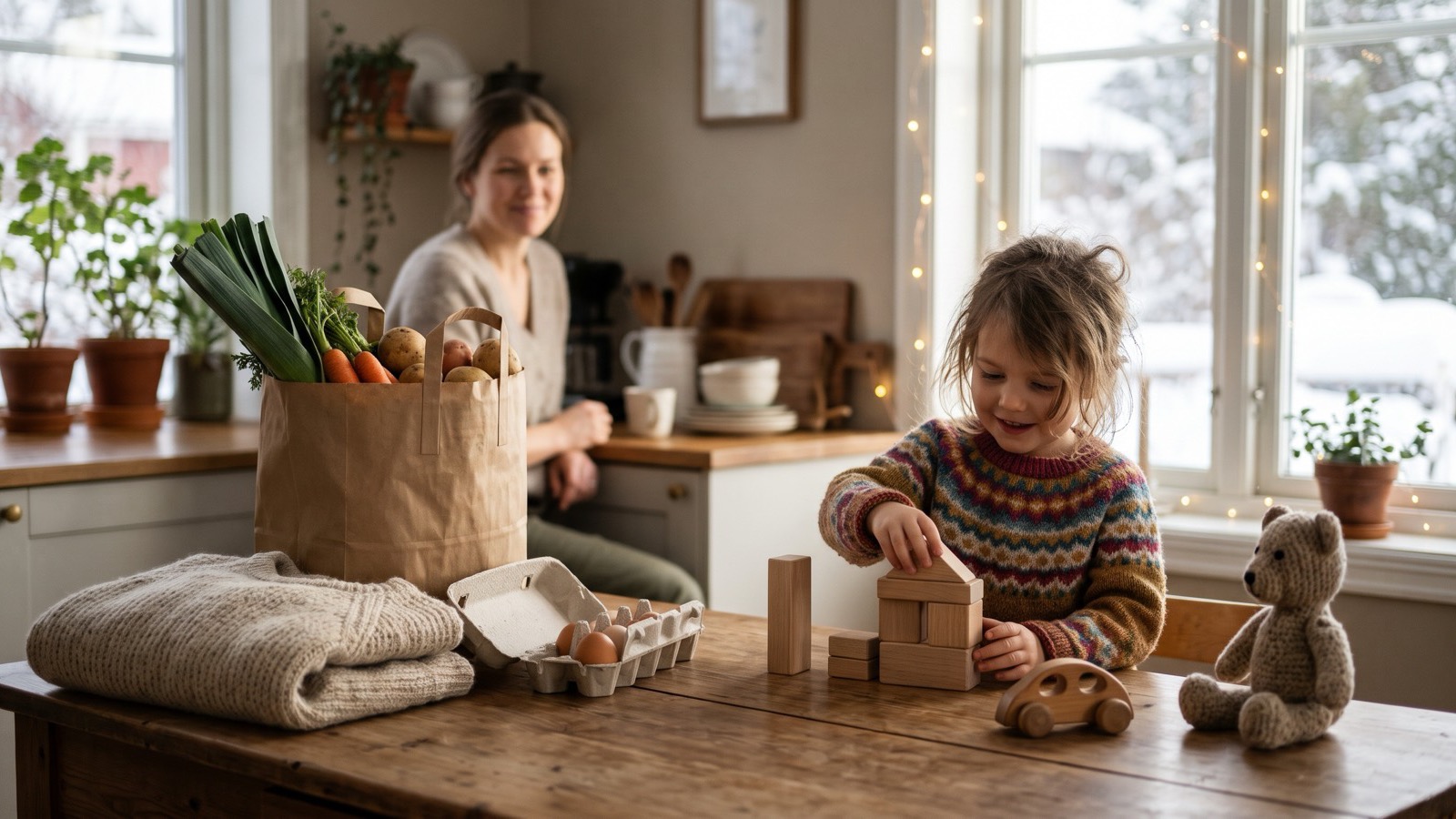
Many of us check where our food is produced, and think twice before buying yet another cheap garment from a budget clothing chain. We know that a low price in the store often means a high price for the environment and for the people who make the clothes, and we like to buy local when we can. But how often do we ask the same questions when we buy toys?
Scandinavian design is known for simple shapes, good materials and things made to be used for a long time. That tradition is found in toys too. Here are some makers with Nordic roots who offer alternatives to mass-produced plastic toys. When you buy toys – for Christmas, a birthday or just because – they are worth a look if you want to support smaller, local makers.
Here you'll see different ways of making better toys: wood and wool instead of oil-based plastic and polyester, plastic that is recycled or plant-based, and technology that gives children a break from the screen.
Behind several of these brands are small, local people: parents, carpenters and founders who started because they missed better toys themselves.
Here are the makers – sorted by how close to Norway the toys are made.
Made in Norway
Pangea – Montessori toys, some of them made in Dovre. Pangea is a Norwegian play and learning company that makes sensory Montessori toys and learning tools. Selected wooden products are made by hand by the joinery workshop Motved in Dovre, an inclusive workplace, from wood from the forest there. Some of the wood is untreated, so each toy is a little unique. The rest of the range is made in China.
Why we like them: local craftsmanship from an inclusive workplace, and natural materials instead of imported plastic.
Beljo – vehicles that grow with the child. Beljo comes from Suldal and makes building sets with wooden blocks and magnetic connectors. With new parts, one toy can be rebuilt into another – a dumper truck can become a forestry machine.
Why we like them: solid, cool design, especially the Black roadster building set, and you can add to what you have instead of buying new.
Made in the Nordics
Viking Toys – plastic toys made to be handed down. A Swedish family company that since 1974 has made vehicles and figures that survive many childhoods. Two ranges are worth looking out for: Ecoline, made of plant-based plastic from sugar cane, and RE:LINE, made of recycled plastic.
Why we like them: plastic without BPA and phthalates, according to Viking Toys, that can be handed down, and two of the ranges are made of plant-based or recycled plastic.
Dantoy – plastic toys that are collected and made new. Family-owned since 1964, with the toys made in its own factory in Denmark. Through its Take Back scheme, old Dantoy toys are collected, washed and turned into new toys.
Why we like them: they are a responsible maker that proves it is possible to think circular.
Plus-Plus – one small piece, endless figures. Developed in Holbæk in Denmark in the 1980s, and still made in the factory there. The factory runs on wind power.
Why we like them: one simple shape that can become almost anything – and that survives years of building.
Micki – Swedish wooden toys since 1944. Micki develops all its wooden toys in Gemla in Sweden, and some of them are made in its own factory there.
Why we like them: classic wooden toys made for several generations of play.
Norwegian brands
These brands are developed in Norway. Rakkerungene says its soft toys are sewn in Germany, while HiRO and Qubs do not say on their websites where the toys are made. The country of manufacture is often on the box, as it is with Qubs.
Rakkerungene – soft toys without polyester. Started by three parents who began to wonder what soft toys are actually made of. The soft toys have a fabric of organic cotton and a filling of pure wool, according to Rakkerungene, and they are sewn in a family-run factory in Germany.
Why we like them: natural materials in something a child holds close every day.
HiRO – sound without a screen. Developed in Grønland, a neighbourhood in Oslo, by three parents of young children who wanted their children to be able to put on music and audiobooks themselves, without a phone or a tablet. The child chooses what to play with cards.
Why we like them: technology on the children's own terms, which lasts through years of listening. And for us grown-ups it is a small reunion with the fairy-tale cassettes of the 1980s – just without the tangled tape.
Qubs – wooden blocks meet technology. Qubs has its head office in Oslo. Qubitunes is an interactive play board in FSC-certified maple, with beech blocks that control sound, games and stories.
Why we like them: screen-free learning in materials that survive many years of play.
We have no agreement with any of these brands, and we earn nothing from mentioning them.
How to spot a good alternative
You don't need a particular brand. Five questions take you a long way:
- Is the material safe and hard-wearing? Wood, wool and cotton are good starting points, but plastic can be a good choice too when it is free of harmful substances, easy to keep clean and made to last. The Nordic Swan Ecolabel and FSC make it easier to check.
- Is it sturdy enough to be passed on? In a British survey, parents said their child loses interest in a toy after 36 days on average. That makes it all the more important that the toy is in good enough shape to delight another child afterwards – look for good quality and timeless design.
- Can it be repaired or built on? When an old toy is fixed or gets a new part, it can feel new again. The child sees it with fresh eyes, and their imagination has something new to work with – without you having to buy a whole new toy.
- Is it easy to find out who made it? Makers who are open about where and how their toys are made make it easier for you to know what you are buying.
- Can the child play with it in many ways? A block can be a house, a car or a phone – the child decides. That is why open-ended toys often hold a child's interest longer than toys that only do one thing. A small American study of 36 toddlers also found that they played longer and more creatively when they had fewer toys to choose from.
Shop with a clear conscience
In all the rush, it is good to be able to shop with a clear conscience. Just as with food and clothes, we believe it makes a difference to choose small, local makers. And a toy made to last can bring joy to more children than your own. Toys like these deserve to be a child's playmate, not to gather dust on the shelf – even if they are beautiful enough to be decoration.
Buying pre-loved isn't a bad idea either. You'll find Plus-Plus, Micki and Viking Toys pre-loved on Loopyty. And the day your child has outgrown a toy, you can sell it or give it away – all you need to do is take two photos. That way it gets a new chapter and new adventures with a new family.
Do you know more makers whose toys last? Tell us, and we'll include them when we update the list.
Want to read more? Here is our advice on sustainable Christmas gifts for kids.
Sources
- Dauch et al. (2018): The influence of the number of toys in the environment on toddlers' play, Infant Behavior and Development
- British Heart Foundation (2019): survey on how long children stay interested in a toy, reported in HuffPost UK
Questions and answers
Are there toys made in Norway?
Yes, but not many. Pangea makes selected wooden toys with the joinery workshop Motved in Dovre, and Beljo from Suldal makes wooden building sets.
Are plastic toys always a bad choice?
No. Plastic that is free of harmful substances, made to last and able to go on to another child can be a good choice. Viking Toys has ranges made of plant-based and recycled plastic, and Dantoy collects old toys and makes new ones from them.
How do I spot a toy that lasts?
Look for safe, hard-wearing materials, a toy that can be repaired or built on, and one the child can play with in many ways. The Nordic Swan Ecolabel and FSC make the material easier to check.